

English
Content
A concrete balcony that has seen better days, a rooftop terrace covered with an aging waterproofing membrane, a patio with cracked pavers that you do not want to tear out — these are exactly the situations where WPC interlocking deck tiles come into play. Conventional decking feels like overkill in these situations: it demands joists, screws, cutting, and days of work. WPC interlocking deck tiles were designed to solve that problem — they form a complete outdoor floor that clicks together directly on top of the existing hard surface, with no substructure and no permanent fasteners.
In short, these tiles are square composite panels with a self-locking base. You lay them edge to edge, lock them together, and create a floating wood-plastic composite floor in a single afternoon. The result is the look of timber decking with less maintenance, and the installation can be reversed whenever you want. That combination of speed, cost, and flexibility is why interlocking deck tiles keep appearing on balconies, rooftops, patios, and pool terraces.
The key difference between interlocking deck tiles and traditional composite deck boards comes down to three things: material format, installation logic, and reversibility.
Interlocking deck tiles are made from the same family of materials as conventional WPC decking — typically wood flour, recycled high-density polyethylene, and processing additives. The difference is that they are compressed into a compact tile rather than extruded as a long plank. The composite core keeps the warm look of wood grain on the surface while removing most of wood's weaknesses: it will not rot, split, splinter, or attract termites, and exposed sections absorb very little moisture compared with natural timber.
Because the tiles rest on the subfloor and lock together at the edges, the entire system is removable. Renters can take the floor to the next apartment. Homeowners can reconfigure a terrace layout or lift a few tiles to access the drainage below. And because no screws penetrate the subfloor, the waterproofing membrane on a balcony or rooftop stays intact — which is often the single most important reason architects specify interlocking tiles over traditional decking.
Not every interlocking deck tile performs the same in real weather. The differences hide in the base structure, the surface finish, and the quality of the recycled polymers. These four traits separate a tile that lasts a decade from one that disappoints after two summers.
The composite core resists water, but how the tile moves water matters just as much. A well-designed tile has drainage channels under the base and small gaps between locked tiles, so rain or pool water passes through quickly instead of pooling on the surface. The base feet keep the body elevated, allowing air to circulate underneath and preventing trapped moisture from damaging the subfloor. For the full technical picture, this review of how WPC interlocking deck tiles handle rain and pool water explains the drainage behavior in detail.
A smooth deck surface becomes dangerous after rain. Safer tiles use a brushed grain, grooved profile, or a deep 3D embossed texture. The deeper the surface relief, the better the wet traction — which is why 3D embossed tiles are a common choice around swimming pools, where bare feet and wet surfaces meet constantly.
Ultraviolet exposure degrades unprotected polymers and fades pigments over time. Cheap tiles can turn gray unevenly within two seasons. Look for UV-stabilized pigments or a co-extruded protective cap layer; the cap layer is the same technology used on premium composite decking, and it provides dramatically better resistance to fading, scratching, and surface chalking.
Stand on a sample tile before buying. A tile that flexes noticeably under one person's weight will feel unstable with a lounge chair or a group of guests. Rigidity comes from the base structure: the number of support feet, the height of the ribs, and the wall thickness of the composite. Solid or thick-walled bases are the safer choice for high-traffic terraces and commercial spaces.
Installation is genuinely DIY-friendly, but a few details determine how flat and how durable the finished floor will be.
The most important requirement is levelness. Interlocking tiles absorb small irregularities, but large dips or slopes will make the floor feel uneven and can loosen the edge connections over time. Flat concrete is ready to go immediately. For moderately uneven pavers or a worn surface, thin support pads or a leveling sand layer usually solve the problem. Our detailed guide on installing WPC interlocking deck tiles over existing concrete or uneven surfaces covers the practical limits and simple correction methods.
No outdoor space is a perfect grid, so at least a few tiles will need trimming around walls, posts, or curved borders. A standard circular saw with a fine wood blade cuts WPC cleanly; cut from the finished face down to minimize chipping. Leave an expansion gap of roughly 5 mm at fixed walls, because composite material still expands and contracts slightly with temperature changes.
Once locked in place, the tiles sit on their raised base feet, and water flows through the gaps and drains away at the perimeter. This constant airflow beneath the tiles is one of the main reasons they work so well on balconies and rooftops — it keeps both the tile underside and the subfloor dry. For a full walkthrough of layout planning and edge details, see these installation methods and usage recommendations for WPC interlocking deck tiles.
If you want a dependable starting point for a first project, our easy-to-install DIY interlocking deck tiles use a tooth-groove locking system that presses together without any extra hardware.
 Wholesale Easy to install WPC interlocking deck tile diy deck tiles ManufacturerANHUI LINYUANWAI NEW MATERIALS CO., LTD is China wholesale Easy to install WPC interlocking deck tile diy deck tiles manufacturers and OE...View Product →
Some budget-friendly tiles use a hollow underside to save material and shipping weight. That approach lowers cost but also lowers rigidity, and it can create a hollow, drum-like sound when you walk across the floor. Solid-base tiles cost more to ship, but they feel substantial underfoot, distribute point loads more effectively, and hold their locking connections more securely. For any area that will see regular entertaining or heavy furniture, solid is the right call.
The surface is where you notice quality every single day. A standard brushed finish looks good and provides moderate wet traction. A 3D embossed finish presses deeper wood grain into the surface, which looks more realistic and grips bare feet noticeably better when wet. A co-extruded finish adds a dense protective cap over the composite core, giving the best scratch resistance, stain resistance, and color retention over the long term.
| Surface finish | Wet slip resistance | Scratch resistance | Color retention | Best suited for |
|---|---|---|---|---|
| Standard brushed | Moderate | Moderate | Fair | Balconies with light traffic |
| 3D embossed | Good | Moderate | Good | Pool surrounds, outdoor dining |
| Co-extruded cap | Good | High | High | High-traffic terraces, commercial decks |
If your priority is a floor that can absorb daily use without showing it, start with a durable WPC composite interlocking deck tile built around a solid base and a thicker wear layer.
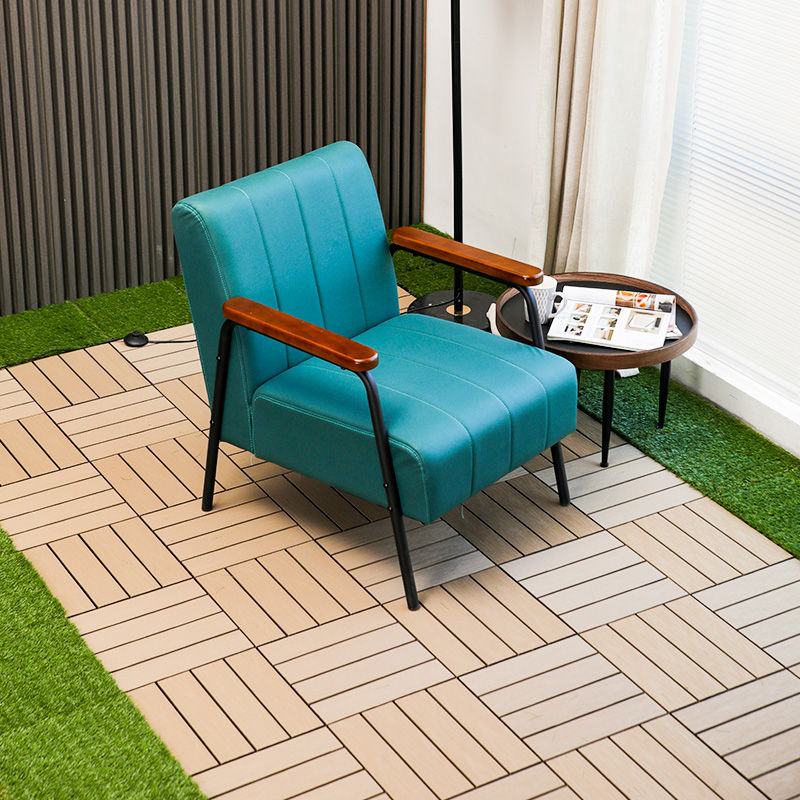 Wholesale Durable WPC Composite Interlocking Deck Tile Outdoor Wood Plastic TileANHUI LINYUANWAI NEW MATERIALS CO., LTD is China wholesale Durable WPC Composite Interlocking Deck Tile Outdoor Wood Plastic Tiles manufa...View Product →
Interlocking deck tiles demand far less upkeep than wood, but they are not zero-maintenance. A broom or leaf blower keeps debris out of the gaps, and a garden hose removes most surface dust. For dirt that has settled into the grain, a mild soap solution and a soft brush are sufficient — no harsh chemicals required.
Pressure washing is generally safe on WPC interlocking tiles, but keep the jet moving and avoid aiming a narrow nozzle directly at the seams for extended periods, since the water force can loosen the locking tabs over time. In shaded, damp spots, algae and moss can appear on the surface. The two most effective preventatives are regular cleaning and making sure water drains freely at the perimeter instead of accumulating at the edges.
These tiles shine wherever a permanent substructure is impractical or unwanted:
For a residential garden or balcony, a wood-grain interlocking deck tile for garden and balcony floors gives you the visual warmth of timber with none of the sanding, staining, or sealing. For commercial rentals, the ability to dismantle the entire floor at the end of the season and reuse it at the next location makes these tiles a genuinely economical option.
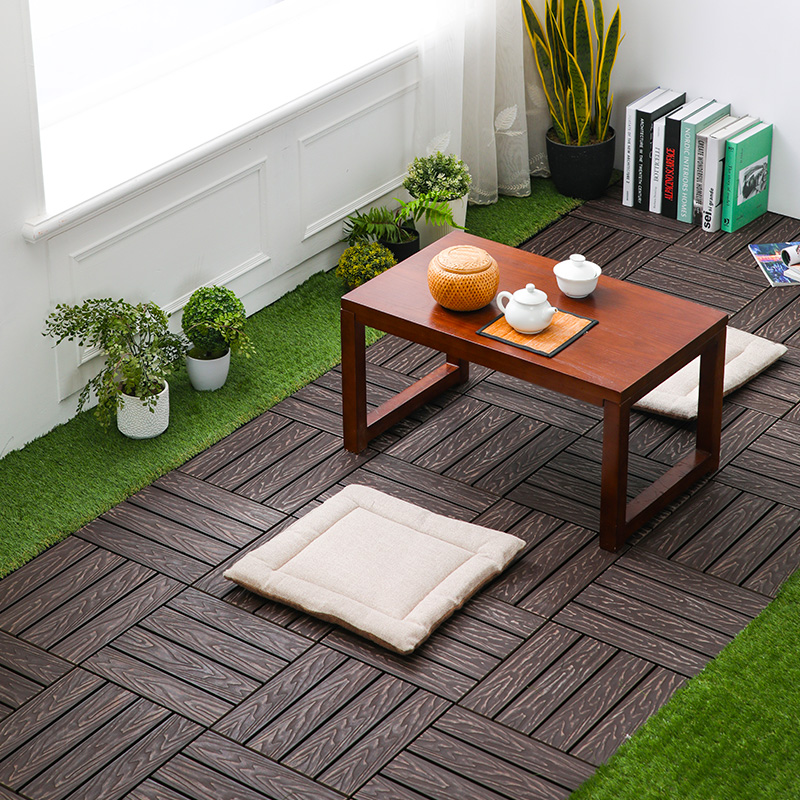 Wholesale Wood Grain WPC Interlocking Deck Tile for Garden Balconies ManufactureANHUI LINYUANWAI NEW MATERIALS CO., LTD is China wholesale Wood Grain WPC Interlocking Deck Tile for Garden Balconies manufacturers and O...View Product →
The deciding factors in any deck tile purchase are rarely about color — they are about the base structure, the surface finish, and the drainage design. A rigid tile with a UV-stable, slip-resistant surface and a well-engineered locking mechanism will perform for years on a balcony, rooftop, or patio. Buy from a manufacturer that can explain those details clearly and back them with third-party testing — look for ISO 9001 quality management, CE marking, or FSC certification as a starting point.



ANHUI LINYUANWAI NEW MATERIALS CO., LTD
We are a professional manufacturer of WPC plastic wood products.
 86-19550246256
 86-19706802653
 SHIZIPU ECONOMIC DEVELOPMENT ZONE. LANGXI COUNTY, XUANCHENG CITY. ANHUI PROVINCE
Scan code Attention to follow us

Copyright © ANHUI LINYUANWAI NEW MATERIALS CO., LTD All Rights Reserved.
 English
 Français

