

English
Content
The first thing a fence buyer usually notices after two summers is not the posts or the rails. It is the color. On a traditional WPC fence, the side that faces the afternoon sun fades faster than the shaded side, and in some regions the surface begins to chalk or the exposed board ends start to swell. This is the most common complaint that comes back to fence manufacturers, and it explains why the market has shifted from single-layer boards to WPC co-extrusion fencing. The conclusion is straightforward: co-extrusion does not make a composite indestructible, but it removes most of the stresses that damage fences long before the core material wears out.
Co-extruded WPC fencing starts with the same material family as a conventional WPC fence board: a blend of wood fiber and recycled high-density polyethylene extruded into a hollow or solid profile. The difference is a second polymer cap fused around all four sides of the board during the same production pass. This cap is not a painted coating or a laminated film. It bonds to the core while both materials are hot, so it cannot peel away the way a surface wrap can.
Most buyers first encountered the cap layer in co-extrusion WPC decking, where it became a standard upgrade for scratch and fade resistance. Fences expose a board to a more uneven set of conditions, and in vertical applications the cap matters even more. A technical walkthrough of how WPC co-extrusion fencing is made is useful background if you are sourcing for the first time. From a production standpoint, a panel with a full cap layer and a correctly formulated core, such as this durable, eco-friendly composite garden WPC co-extrusion fencing, eliminates most of the failures that normally appear in warranty claims.
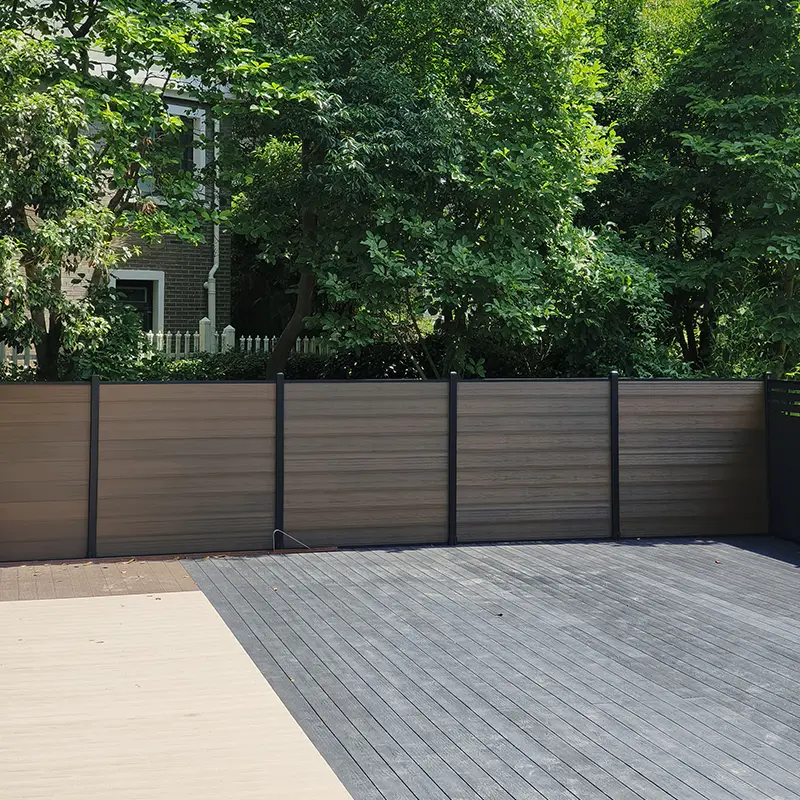 Wholesale Durable Eco-Friendly Composite Garden WPC Co-Extrusion Fencing ManufacANHUI LINYUANWAI NEW MATERIALS CO., LTD is China wholesale Durable Eco-Friendly Composite Garden WPC Co-Extrusion Fencing manufacturers a...View Product →
Co-extrusion is usually discussed as one feature, but it changes behavior at several separate failure points.
A fence is a vertical surface with two very different microclimates a few centimeters apart. One side receives hours of direct sun; the other stays in shadow and often remains damp. An unprotected WPC face will fade and chalk on the sunny side while the shaded side keeps its original tone, and the contrast becomes obvious within two or three seasons. A co-extruded cap contains UV stabilizers and pigments that resist photodegradation better, so both faces age at a similar rate.
The joint between a board and its rail or post is where water sits the longest. On a traditional WPC board, the edges are more open to moisture, and swelling at the ends can push boards out of alignment or crack fastener holes. The cap layer wraps the edge profiles, which reduces the amount of water that reaches the wood-plastic core.
The lowest board in a fence line lives in the splash zone. It is exposed to soil moisture, irrigation overspray, and rain runoff. In an uncapped board, continuous wetting accelerates deterioration of the wood fiber inside the core even when the surface still looks intact. A capped surface slows water ingress enough to make a measurable difference in service life.
Dark fence colors absorb heat, and long horizontal runs of WPC expand and contract as temperatures change. In extreme heat, an unprotected dark surface can soften slightly and pick up marks. The cap layer is formulated with a higher heat tolerance, which reduces surface softening and helps the board hold its profile. In hot climates, the cap composition matters as much as the core recipe. For high-heat projects, a high-temperature-resistant outdoor WPC co-extrusion fencing panel is a safer specification than an uncapped board.
 Wholesale Natural Real Wood-Look WPC Fence Manufacturers, OEM/ODM Company - ANHUANHUI LINYUANWAI NEW MATERIALS CO., LTD is China wholesale Natural Real Wood-Look WPC Fence manufacturers and OEM/ODM company, Natural Re...View Product →
Before comparing prices per linear meter, compare how the two material types behave under the same outdoor exposure. The table below summarizes the differences that show up in the field.
| Performance area | Single-layer WPC fencing | Co-extruded WPC fencing |
|---|---|---|
| Color retention | Fades unevenly; surface chalking can appear within 2-4 years in high-UV regions. | Cap holds color longer; the two faces fade at a closer rate. |
| Edge moisture resistance | Board ends absorb water; swelling occurs in wet climates. | All four sides are capped; edge water uptake is much lower. |
| Scratch resistance | Scratches expose the core and are difficult to repair. | Cap resists scratching; light marks stay within the color layer. |
| Maintenance | Annual cleaning; occasional brightening or refinishing. | Soap and water; no sealing, staining, or painting. |
| Typical service life | Often needs board replacement or refinishing in 5-10 years. | Designed to stay serviceable beyond 15 years with proper installation. |
| Cost profile | Lower purchase price. | Higher purchase price; lower whole-life cost. |
A co-extrusion claim is easy to write on a spec sheet and harder to verify on a sample. These five checks will catch the most common gaps.
One more detail that is easy to overlook: the cap protects the board, not the frame. Co-extruded panels are usually paired with aluminum, steel, or the manufacturer's own WPC post system. Mixing incompatible post materials can create expansion stress or galvanic corrosion at connection points, so verify the complete system rather than just the board.
Choosing a cheaper material is a legitimate decision when it is made with full information. Single-layer WPC fencing still fits budget-driven perimeter runs, temporary screening, agricultural enclosures, and projects with a maximum design life of around ten years in a mild climate. But if the fence is visible, residential, or located in a high-UV or high-humidity area, the additional cost of co-extrusion is justified in nearly every case. The projects that fail economically are the ones where an uncapped board is installed in a harsh environment and then has to be replaced early.
Co-extruded fencing carries a higher price per meter, and the premium is reasonable: it pays for a more complex extrusion line, more polymer per board, and stricter quality control. The whole-life calculation is simple. If a standard fence needs board replacement in year six and a co-extruded fence is still holding its color in year twelve, the premium paid at the order stage is much smaller than the cost of removal, new materials, freight, and installation labor. For most buyers, the question is not whether they can afford co-extrusion, but whether they can afford to replace a fence twice in the same period.
Co-extrusion is not a premium label on an ordinary fence. It is a different manufacturing process with measurable field benefits in UV resistance, moisture management, edge protection, and dimensional stability. Verify the cap on a cut sample, request test data, and source from a manufacturer that controls the full production line. A WPC fence manufacturer with in-house co-extrusion can usually adjust cap thickness, colors, and profile details to match project requirements.
For residential and privacy projects, an easy-to-install outdoor composite privacy garden WPC fencing system cuts labor time while still delivering the capped surface you are paying for. Specify a full cap, verify the core, and the fence you install this year will still be the fence your client sees ten years from now.
 Wholesale Low-Maintenance Co-Extruded WPC Fence Manufacturers, OEM/ODM Company -ANHUI LINYUANWAI NEW MATERIALS CO., LTD is China wholesale Low-Maintenance Co-Extruded WPC Fence manufacturers and OEM/ODM company, Low-M...View Product →



ANHUI LINYUANWAI NEW MATERIALS CO., LTD
We are a professional manufacturer of WPC plastic wood products.
 86-19550246256
 86-19706802653
 SHIZIPU ECONOMIC DEVELOPMENT ZONE. LANGXI COUNTY, XUANCHENG CITY. ANHUI PROVINCE
Scan code Attention to follow us

Copyright © ANHUI LINYUANWAI NEW MATERIALS CO., LTD All Rights Reserved.
 English
 Français

