

English
Content
Stand at any composite decking display and you will quickly understand the real difficulty of color selection. A rack of boards labeled "brown" can contain one sample that looks like pale honey, another that reads as reddish mahogany, and a third that is almost black coffee. It is easy to treat color as a finishing touch, but with composite decking, color is the most permanent and physically active decision you will make. It determines surface temperature on a summer afternoon, how quickly dust and pollen become visible, how the deck behaves after five or ten years of sun, and whether the finished terrace looks like a deliberate extension of your home or simply a pile of planks. Choose the color family before you compare prices, profiles, or installation systems.
The first thing to understand is that you cannot repaint composite decking the way you can repaint a timber deck. Wood accepts a new stain; composite materials are colored by pigments mixed into the wood-plastic compound or locked inside a protective cap layer. If you grow tired of the color, replacing boards is the only realistic path back. That makes the choice permanent in a way that many buyers do not fully appreciate until after installation.
The color also sets the visual budget for the entire garden. A warm wood-tone deck pulls the eye toward outdoor furniture and greenery, while a cool grey deck pushes attention toward the edges, planters, and architectural lines. A very dark surface makes a small courtyard feel snug but can visually shrink the space; a light surface reflects daylight, which is why lighter boards are often chosen for balconies and compact terraces. None of these effects is dramatic on a single sample board, but on a 40-square-meter terrace they define the atmosphere.
For most projects, the search narrows to four families: natural wood tones, greys, warm earth tones, and dark browns. Each family behaves differently in real daylight and in real use.
| Color family | Typical shades | Character in use | Best suited to |
|---|---|---|---|
| Natural wood tones | Teak, walnut, cedar, mahogany | Timeless, easy to combine with garden furniture; hides a wide range of soiling | Traditional houses, gardens, pool surrounds |
| Greys | Driftwood, slate, charcoal | Modern and cool; complements stone and concrete; lighter greys show pollen and dust clearly | Contemporary architecture, rooftop terraces |
| Warm earth tones | Sand, tan, khaki | Neutral and bright; lower heat build-up; shows organic leaf stains more easily | Mediterranean styling, open sunny yards |
| Dark browns | Espresso, coffee bean | Formal and dramatic; absorbs heat; shows dust, footprints, and tree pollen quickly | Shaded yards, commercial terraces, balconies |
When in doubt, natural wood tones remain the safest choice because they work with almost any exterior material and age visually. If you want a distinctly modern look, grey is the strongest direction, but choose the lightest grey you can tolerate if the deck sits under trees.
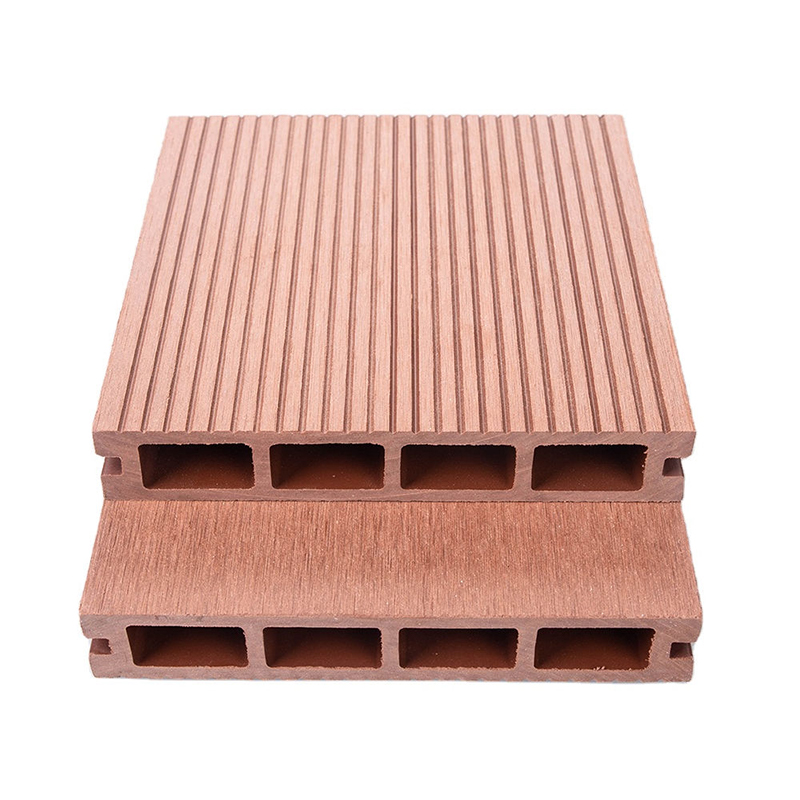 Classic Wood-Tone WPC Decking for Garden and Courtyard FlooringA natural wood-toned composite decking with through-body color, suitable for gardens and courtyards. Its moisture resistance and dimensional stability make it a dependable choice for budget-conscious outdoor projects.View Product →
Classic wood-tone WPC boards with a through-body color remain a reliable default for budget-conscious projects. If the supplier offers a full-size sample of that shade, check it against your walls and paving before ordering the full quantity.
Before choosing a shade, find out how the color is held inside the board, because that determines how the color will behave over its life.
Classic WPC boards are colored through the full thickness of the profile. The pigment is mixed into the wood-plastic compound, so minor scratches expose the same or similar color underneath. The practical tradeoff is that the surface wears evenly with time, and the board tends to fade more visibly because the pigment is not protected by a dedicated surface layer.
Co-extruded boards are different: a solid outer cap is fused around the core, and the color and UV protection live inside this cap. The cap resists scratching, staining, and moisture, and it carries a UV barrier that slows the fading process significantly. If color stability is your first priority, a co-extruded board is the more reliable investment.
 Co-Extrusion WPC Decking with UV-Resistant Outer CapThis co-extruded composite decking features a solid outer cap that resists scratching, staining, and fading. It is ideal for high-traffic public spaces where long-term color stability and durability are essential.View Product →
Co-extrusion also reduces the color-related problems that appear with ordinary composites: fading, a chalky surface, and visible scratches. You can read more about how the outer cap handles these conditions in our detailed review of coextrusion WPC decking.
All composite decking fades to some degree; the difference between products is how fast and how evenly the change happens. Pigment quality, cap thickness, and UV stabilizers control that rate. A trustworthy supplier should provide a published color-hold statement based on accelerated weathering tests, for example ASTM D7031 or a comparable standard, rather than a vague "fade-resistant" claim.
Expect the most pronounced change during the first season. Engineered composite surfaces oxidize slowly in sunlight, and lighter colors usually show less visual change than deep browns or charcoal shades. In practice, a medium wood tone retains its character for many years, while a very dark deck can take on a slightly chalky appearance sooner. Ask directly about replacement color availability: composite lots can vary between production batches, and buying one or two spare boards with the same batch number at the time of purchase is the simplest insurance you can take.
If you are still hesitating between a light and a dark shade, the decisive factors are usually heat and soiling.
If the deck is exposed to direct afternoon sun, choose a light or medium shade even if the design concept calls for dark. You can keep the dark accent on the railing or the planters instead.
Two boards with exactly the same color look completely different when one has a smooth surface and the other has a deep wood-grain relief. Embossed surfaces create shadows inside the grain, so the color appears richer and the board avoids the flat, plastic look. A smooth board in a strong brown can look artificial; the same brown with a realistic grain relief reads as natural, especially in low evening light.
 3D Embossed Wood Grain WPC Decking for Realistic TextureA high-density composite decking with deep 3D wood-grain relief that enhances color depth and slip resistance. The textured surface hides minor marks and suits gardens, balconies, and pool areas.View Product →
3D embossing adds a tactile depth that does more than improve grip; it changes how color is perceived from different angles and in wet conditions. Texture also affects maintenance visually: a relief surface hides minor dust and foot traffic marks, but you should confirm that the pattern still allows easy brushing in the direction of the grain.
Composite decking color is not the kind of decision you can reverse with a coat of paint. Choose a color family that fits your architecture and climate, verify the color technology behind the board, and confirm the fade warranty in writing. Do that before the boards arrive, and you will not spend the next decade wishing you had picked the other shade.



ANHUI LINYUANWAI NEW MATERIALS CO., LTD
We are a professional manufacturer of WPC plastic wood products.
 86-19550246256
 86-19706802653
 SHIZIPU ECONOMIC DEVELOPMENT ZONE. LANGXI COUNTY, XUANCHENG CITY. ANHUI PROVINCE
Scan code Attention to follow us

Copyright © ANHUI LINYUANWAI NEW MATERIALS CO., LTD All Rights Reserved.
 English
 Français

