

English
Content
A deck color chosen from a screen is a guess; a deck color chosen from a sample you can hold against the siding is a specification. Composite boards carry pigment in the core, a protective cap layer on the surface, and an embossed grain that scatters light, so the same reference number can read warm at noon and grey by six in the evening. Buyers who end up happy treat color as a technical decision with a checklist, not a mood.
Three facts drive everything below: color names describe families rather than exact shades, capped and uncapped boards age differently, and the light falling on your specific site changes the outcome more than any catalogue photo can.
Color on a composite board is a system of three parts: core pigment, cap layer, and surface texture. Change one of them and the shade you see on the finished deck changes with it.
Composite decking color is produced by three separate decisions: the pigment blended into the core, the co-extruded cap layer bonded over it on premium boards, and the depth of the embossed grain rolled into the surface.
The core pigment sets the base tone. On uncapped decking that pigment runs through the whole profile, so a deep scratch exposes a similar color instead of a pale line. On capped boards the visible color comes from a thin polymer shell that also carries the UV stabilizers, which is why co-extruded products hold their tone longer under hard sun.
An uncapped board will lighten and grey over the first few seasons, and it can be sanded or re-stained later if you want to correct the tone. A capped board keeps its factory color for much longer, but that color is locked at the factory, so the sample you approve is close to what you will live with for a decade or more.
Deeper embossing creates more shadow lines across the surface, and those shadows make the same pigment read darker and warmer from standing height. A shallow, lightly brushed finish reflects more light and can appear a full step lighter under the same sky.
 3D Embossed Wood Grain Composite WPC Decking FlooringWe have 3D embossed WPC decking flooring in a variety of colors for you to choose from, with realistic textures, clear and delicate WPC textures, strong sustainability...View Product →
Pigment loading, cap thickness, gloss level, and lot number all move the final tone. Two boards sold under the same name by different factories can sit two or three visible tones apart, and even a single factory will show a slight shift between production batches.
| Color family | Undertone | Works well for | Watch out for |
| Warm brown or teak | Red to yellow warm | Woodsy yards, brick and stone facades | Red undertones can fight cool grey siding |
| Grey or weathered | Neutral to cool | Modern homes, coastal and urban settings | Light greys show tannin and dust sooner |
| Blonde or light sand | Low-saturation yellow | Small courtyards, shaded patios, pool surrounds | Strong sun can wash out grain detail |
| Red or mahogany | Deep warm red | Traditional facades, rich planting schemes | Red pigment is the hardest to keep even across batches |
| Charcoal or black | Cool neutral to blue-grey | High-contrast contemporary designs | Surface heat in full sun and visible dust |
| Multi-tonal variegated | Mixed, streaked | Any setting where a natural board look is wanted | Streak direction should be checked on site first |
A color name describes a family, not a fixed finish. Ask for the exact board profile and a sample cut from the current production batch before approving a full order.
The same board can look warm at nine in the morning and cool grey by late afternoon, because reflected light, sky color, and nearby surfaces do as much visual work as pigment.
Orientation is the biggest variable. South and west elevations take direct sun for most of the day, which is where dark boards absorb heat, stay hot underfoot, and work their cap layer hardest. North-facing and shaded decks hold a more even color through the day, though surrounding foliage can push a grey or green shade slightly greener.
In high-UV and coastal locations, co-extruded decking built to resist scratching and fading holds its tone noticeably longer than an uncapped board, which is the practical reason to compare cap technology before comparing swatches. The UV and moisture behavior of WPC tiles follows the same logic: a stabilized surface keeps its color, and an exposed core does not.
Dark boards hide stains better and read richer in shade; light boards stay cooler underfoot and forgive scuffs. The trade-off is about heat and visibility, not about quality.
Match the undertone first, then the value. Undertone is whether the color sits on a warm red-yellow base or a cool grey-green base; value is simply how light or dark the board is, and the two are decided in that order.
Most mismatches happen when a buyer picks a value they liked in a photo and ignores the undertone of the siding, roof, and paving already on site. Warm browns beside cool grey siding fight each other, while the same brown beside brick reads as the obvious choice.
Order every WPC product in one project from the same color reference and, wherever the schedule allows, from the same production batch.
Cap layers, embossing depth, and joint spacing all shift how a color reads between product lines. An interlocking deck tile with tight joints can look a shade darker than a deck board from the same family, and a vertical co-extruded panel catches less direct sun than the floor, so it can appear deeper again.
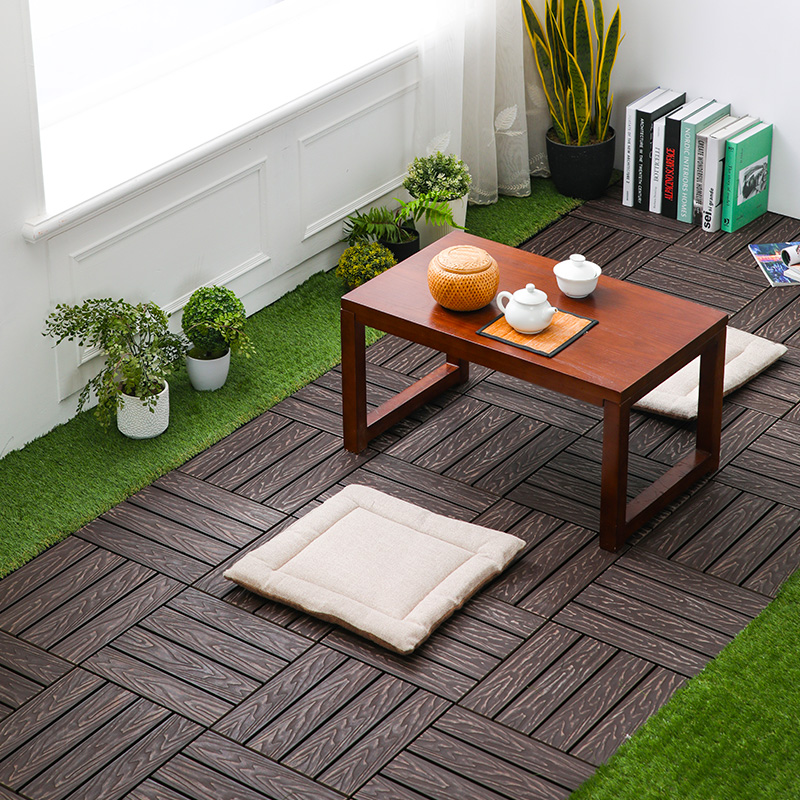 Wood Grain WPC Interlocking Deck Tile for Garden BalconiesThanks to the weight of the WPC interlocking deck tiles, once interlocked with other Tiles, a stable surface is created and should not become dislodged with everyday u...View Product →
Boards run the longest sightline in the project, so lock the deck batch first and match everything else to it.
Tight joint lines and heavier embossing make tiles read slightly darker than boards in the same family.
Vertical surfaces catch less direct light, so fencing and wall panels often look a shade deeper than the floor.
One reference color across decking, tiles, fencing, and panels reads as a single design decision. Four near-matches read as a mistake, even when each product is perfectly good on its own.
Order physical samples, view them in the exact location at two times of day, then commit the whole project to one production batch.
Samples lying on a lawn in the shade tell you almost nothing. Tape them to the frame where the deck will actually sit and leave them there for a full afternoon.
Cap-protected boards fade slowly and evenly, and most change is complete within the first few seasons. Uncapped boards lighten and grey more noticeably, but they can be cleaned, sanded, or re-stained later, which gives you a way to correct the tone without replacing boards.
Warm mid-tone browns with multi-tonal streaking and a deep embossed grain come closest, because real timber is never a single flat color. Avoid uniform, glossy finishes if a natural look matters more than a clean, engineered appearance.
Darker surfaces absorb more solar heat, so charcoal and black boards can be uncomfortable barefoot in full afternoon sun. Light greys and blondes stay noticeably cooler, which matters most around pools and children's play areas.
Sometimes. Ask for a physical sample of the current batch and compare it against the existing material in daylight, since an older surface will have aged slightly. A small difference is normal; keeping everything in one color family makes it far less visible.
Color decisions get easier once you separate the three variables: undertone, value, and cap technology. Settle those in order, confirm them with samples on site, and the finished deck will match the plan instead of the brochure.



ANHUI LINYUANWAI NEW MATERIALS CO., LTD
We are a professional manufacturer of WPC plastic wood products.
 86-19550246256
 86-19706802653
 SHIZIPU ECONOMIC DEVELOPMENT ZONE. LANGXI COUNTY, XUANCHENG CITY. ANHUI PROVINCE
Scan code Attention to follow us

Copyright © ANHUI LINYUANWAI NEW MATERIALS CO., LTD All Rights Reserved.
 English
 Français

